TOTAL NUMBER OF SPECIES RECORDED IN BRITAIN AND IRELAND COMBINED IN 2015

As of 10 November 2015, a total of 430 species have been recorded this year

Total Pageviews

Wednesday, 30 June 2010

GULL-BILLED TERN now in West Dorset


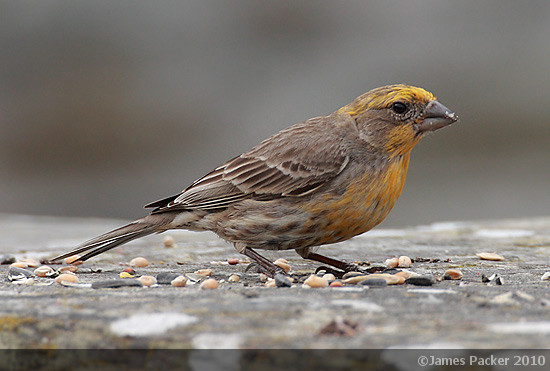
Mexican House Finch, East Prawle village, South Devon, late June 2010 (James Packer) - Perhaps now, with this coastal movement, more likely a ship-assisted vagrant rather than an escape
One of the adult GULL-BILLED TERNS from Bowling Green Marsh on Monday has relocated to Abbotsbury (West Dorset), where all afternoon and evening it has been showing off of the beach and over the Swannery meadow

In North Norfolk, a CAMBERWELL BEAUTY butterfly continues to attract visitors to Titchwell RSPB, where it is present for its third day around the picnic and information centre area. North Norfolk also hosts a party of EURASIAN SPOONBILLS at Cley NWT Pope's Marsh

Meanwhile, in South Devon, the orange-yellow variant MEXICAN HOUSE FINCH remains in East Prawle village, and in Somerset, the barking male LITTLE BITTERN at Loxton Marsh, Ham Walls RSPB. The breeding pair of PURPLE HERONS are busily feeding 2 or 3 young in the reedbed nest at Denge Marsh (East Kent) (the RSPB has kindly organised a special viewing platform and event, £3.00 for non-members)

An early returning migrant adult PECTORAL SANDPIPER is today on Gretchen Loch, North Ronaldsay (Orkney) (with male Green Sandpipers now returning and becoming widespread) but in North Lincolnshire, there has been no further sign of the first-summer BONMAPARTE'S GULL seen amongst roosting gulls at Far Ings Reserve.

Tuesday, 29 June 2010

Mexican House Finch still present

The orange-yellow variant MEXICAN HOUSE FINCH remains at East Prawle village in picturesque South Devon. It is loosely associating with House Sparrows and is repeatedly returning to the garden and feeders of 'The Old Cider House', as well as frequently perching on the long roof of 'The Shippen' - all adjacent and just behind the cafe (Piglet Stores) on the village green. The bird appears intermittently and goes missing for long periods of time but repeatedly comes back to the same area of gardens, where it performs very well. It now seems likely that this bird is a ship-assisted arrival from North America, considering its easterly coastal movement between Land's End and Prawle Point, although the possibility of it being an escape still cannot be completely ruled out. Categorization of such an individual is still being looked into, as is that of 21 further species of transatlantic ship-assisted arrivals to Britain and Ireland.

ACCESS INSTRUCTIONS: East Prawle is best accessed from Kingsbridge and the A379, along four miles of very minor and hazardous narrow country lanes. Limited parking is available by the village green upon arrival but please respect the privacy of residents when searching for the bird, preferably avoiding early morning visits. The bird is no longer singing regularly but returns to the gardens perhaps once every two hours, less frequently in the afternoons and evenings.

A pair of GULL-BILLED TERNS were an excellent reward for a local patchworker at Bowling Green Marsh RSPB, Topsham (South Devon) yesterday evening, the two birds remaining until dusk in the high tide gathering of waders, Black-headed Gulls and Sandwich Terns. Just under 25 lucky individuals connected.

Monday, 28 June 2010

CAMBERWELL BEAUTY

A CAMBERWELL BEAUTY butterfly has been seen in the vicinity of the Titchwell RSPB Information Centre this morning whilst belated news concerns a female RED-NECKED PHALAROPE at Maxey GP (Cambs) yesterday

Sunday, 27 June 2010

Dungeness Today

The PURPLE HERONS have been showing beautifully all weekend giving excellent views from the Hooker's pits viewpoint and Denge Marsh hide. A BITTERN continued to boom regularly and on Saturday there was plenty of activity with three individuals seen in flight. At least six Hobbies were seen and the first-summer male RED-FOOTED FALCON was spotted early on Saturday morning - this is actually a different bird than the one seen earlier in the month. A family party of Bearded Tits, several Common Cuckoos, Marsh Harriers and three Common Tern chicks were also of note (Christine Hawkins, Visitor Centre Manager, RSPB Dungeness )

Friday, 25 June 2010

The Friday Review

ROSE-COLOURED STARLINGS are specialities of flaming Junes and this year's representative is a fine adult consorting with Common Starlings in the Porthgwarra and St Levan area of West Cornwall. Meanwhile, a WHITE STORK was seen yesterday morning in a recently cut hayfield by the Millpool turning, 4 miles north of Bodmin (at SX 114 710).

The pair of PURPLE HERONS are now actively feeding young at Dungeness RSPB reserve (Kent) and are best observed from the Denge Marsh road overlooking the reserve near Brick Wall Farm, whilst the adult male LITTLE BITTERN present for its second successive season continues to bark from the reedbed at Loxton Marsh, Ham Walls RSPB (Somerset).

The singing male beautiful red COMMON ROSEFINCH remains on territory in Kinross, favouring the bushes and scrub in the vicinity of the log cabin in the car park adjacent to the Tormaukin Inn (NN 982 049), whilst on Shetland, the adult summer LONG-TAILED SKUA remains paired up with an Arctic Skua at East Burra. On Orkney, their fourth-ever TAWNY PIPIT remains on North Ronaldsay, showing very well on the road towards the north end (first island record).

A female FERRUGINOUS DUCK remains present at Minsmere RSPB reserve (Suffolk), favouring the Island Mere

Late news concerns yet another WHITE-THROATED SPARROW in 2010 - this time in Lincolnshire and present for two days in a Fulbeck garden (18-19 June).

In County Dublin (IRELAND), the TEREK SANDPIPER continues today, showing well this afternoon from the North Hide on the Rogerstown Estuary.

Tuesday, 22 June 2010

TEREK SANDPIPER on the Rogerstown Estuary (County Dublin) for 2nd day - FIRST OF THE YEAR

I saw the TEREK SANDPIPER at Rogerstown today from the South Hide between 3.30 and 4.05pm. It was at the edge of the channel to the right of the hide.It was keeping company with about 20 Common Redshanks. Both the Redshanks and the Terek Sandpiper flew off towards the outer estuary at about 4.05pm . I waited until about 4.30 but I did not connect with it again (John Fox)

Monday, 21 June 2010

Strathbeg CASPIAN TERN


The CASPIAN TERN had returned to the Starnafin Farm pools and was there until at least 3pm, although by 3.45pm it was no longer on view. There has been no further sign of it as of yet, but we will be keeping the Visitor Centre open until late this evening if people want to try coming up for it.The two Eurasian Spoonbills are still in front of the Visitor Centre. For additional pictures of the tern, check out the Strathbeg site at http://www.rspb.org.uk/community/groups/lochofstrathbeg/default.aspx (David Parnaby)